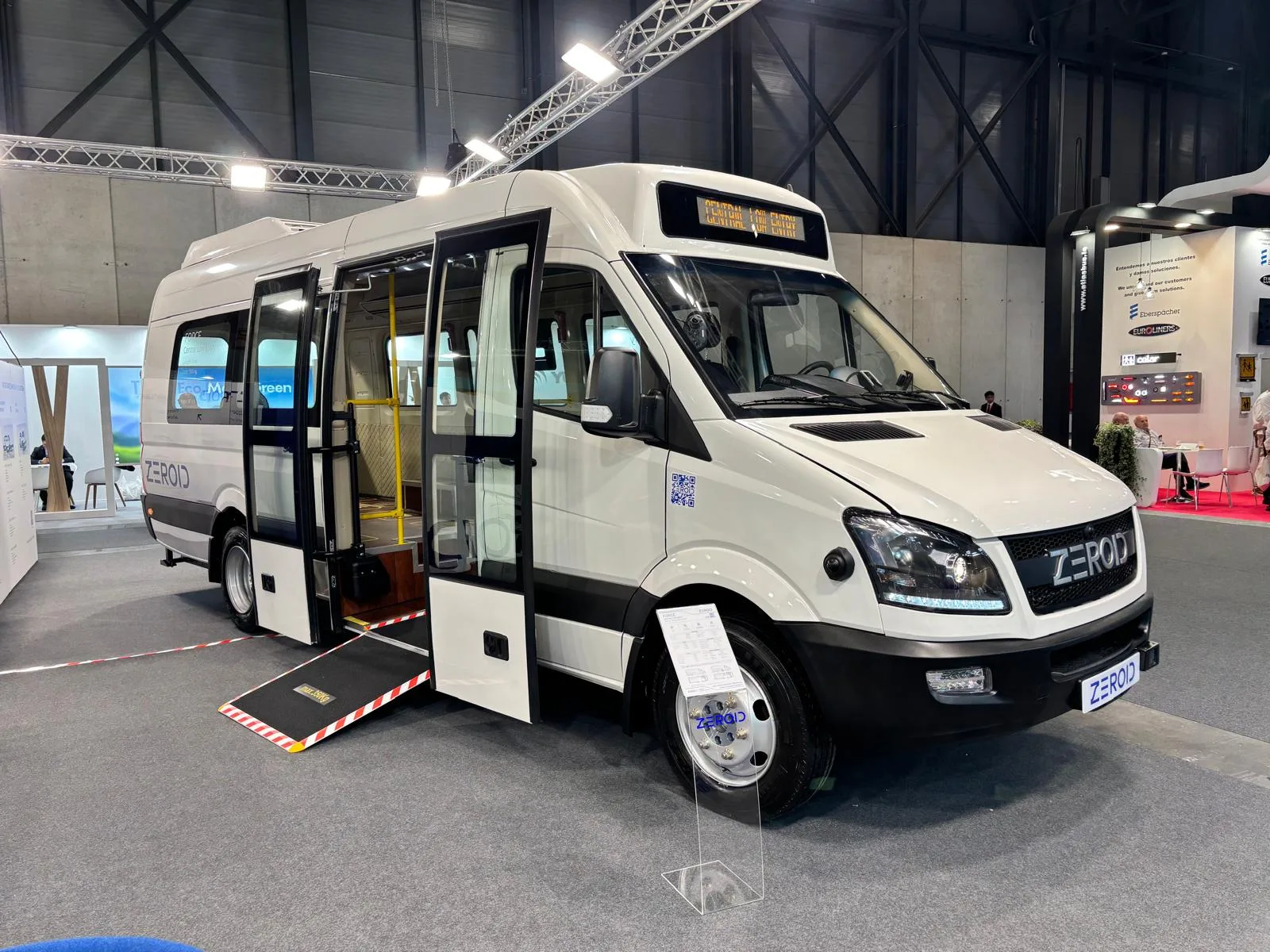
Madrid, 22 September 2026 — ZEROID, QEV Technologies’ electric mobility brand, unveils the new FORCE Central Low Entry for the first time worldwide at FIAA 2026. This M3 electric platform has been developed to simplify the creation of low-floor buses and provide bodybuilders with a technically advanced, flexible and highly customisable base.
The new model features a completely redesigned powertrain, with an integrated axle motor delivering greater smoothness, power and torque, as well as a higher-energy-density battery. It is available with battery capacities of 135 and 170 kWh and, in its 170 kWh configuration, offers a range of up to 352 kilometres according to the SORT cycle and up to 16 hours of operation with air conditioning.
Engineering designed to simplify Stage II
Designed as Stage I of a low-entry bus, the FORCE Central Low Entry incorporates the structural modifications required to create a central low-floor area from the outset. This allows the bodybuilder to develop the final body without having to start from scratch, with an architecture prepared for both structural integration and high- and low-voltage electrical systems.
The platform is homologated in the M3 category and can be completed as either Class A or Class I. Its partial type approvals are already in place, and the design takes into account the dimensional and structural requirements of UN Regulation No. 107 (R107). The interior can accommodate either functional configurations or higher-specification finishes, depending on the operator’s requirements.
Enhanced performance, safety and operational comfort
The vehicle increases its maximum permissible mass to 7,000 kg, with 2,500 kg on the front axle and 5,000 kg on the rear axle. It features disc brakes on both axles, an integrated electric parking brake and rear air suspension as standard. Its safety equipment includes, among other systems, Advanced Emergency Braking, Lane Departure Warning, Blind Spot Detection, Cyclist Collision Warning, Electronic Stability Control and Intelligent Speed Assistance. The vehicle is offered with GSR II and GSR III safety systems.
The unit on display at FIAA features a demonstration configuration at a highly advanced stage of integration, showcasing the potential of the platform and the freedom it offers each bodybuilder and operator in defining the final vehicle configuration.
“With the FORCE Central Low Entry, we aim to offer a comprehensive solution in the search for the ideal urban bus. The much sought-after central low-entry configuration is combined with a latest-generation battery that provides the range required to meet the needs of any daily operation, together with a rear axle featuring an integrated motor and maximised load capacity. It represents another step towards the full electrification of urban passenger transport.”
Joan Orús, CEO of QEV Technologies
The FORCE Central Low Entry will be available for delivery from April 2027. Industry professionals can discover the vehicle at FIAA 2026, from 22 to 24 September, in Hall 9, Stand 9A12A at IFEMA Madrid.
About ZEROID, QEV Technologies’ electric mobility brand
ZEROID develops electric mobility solutions for urban fleets, including vans, chassis, buses and adaptable platforms. QEV Technologies’ expertise in high-performance electric engineering, built through its experience in motorsport, is applied to vehicles designed to meet the real-world needs of operators: From Race to Road.